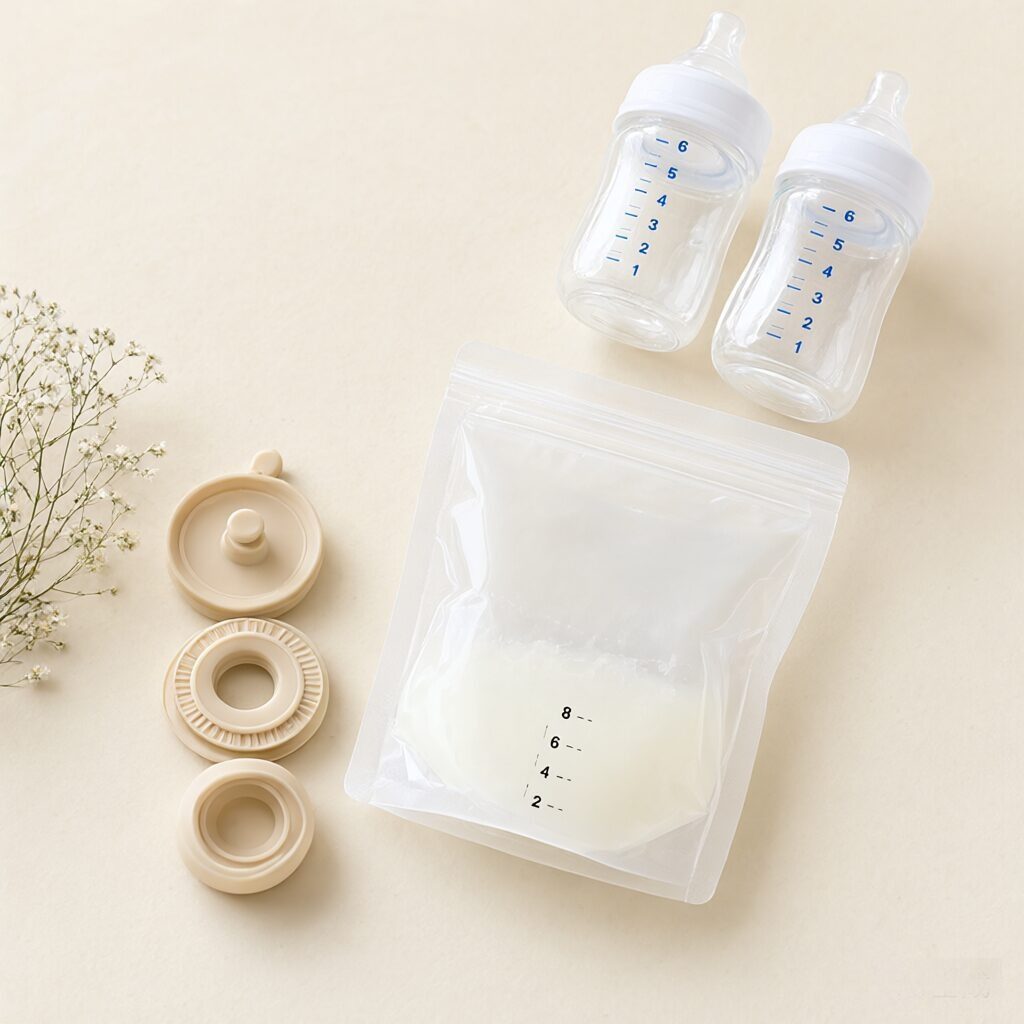
Everything about storing expressed milk reduces to four numbers: how long it can sit at room temperature, how long it keeps in the fridge, how long it keeps in the freezer, and how long a thawed or warmed portion lasts once a feed has started. The rest is technique.
The ranges below follow the published guidance US parents are usually pointed at (CDC human-milk storage guidance and the American Academy of Pediatrics' Caring for Your Baby and Young Child). Check the current version before you rely on it — those documents do get revised, and hospital milk banks sometimes apply stricter limits than home storage.
The four windows
| Condition | Commonly published window |
|---|---|
| Fresh, room temperature (around 25°C / 77°F) | Up to 4 hours. Longer in a cool room, but plan around 4. |
| Refrigerator, back of the main shelf | Up to 4 days for best quality; some guidance extends this when the fridge is very consistent. |
| Freezer compartment inside a fridge-freezer | 2 weeks if the door is opened normally. |
| Standalone / chest freezer kept at −18°C (0°F) | 6 months is the standard target; up to 12 months is often cited for a deep freezer that is rarely opened. |
| Thawed, still in the fridge | Use within 24 hours from when it is fully thawed. Do not refreeze. |
| Warmed, and the baby has started feeding | Use within about 2 hours, then discard what is left. |
| Warmed, untouched | Use within 2 hours or return it to the fridge once, for no more than 4 hours total. Do not reheat a full bottle twice. |
Why the back of the freezer beats the door
Storage time assumes a stable temperature. A freezer door gets opened, and the warmest, most-frequently disturbed items are the ones at the front of the door shelf. Moving the stash to the back of the freezer — or into a chest freezer where the temperature does not swing — is the single change that most often turns a six-month claim into a real six months.
The same logic applies in the fridge. The door is the warmest part and the item that changes temperature most, so the door is exactly where expressed milk should not live.
Fill, seal, lay flat, then stand it up
- Fill to the volume the bag or container is rated for, leaving headspace — milk expands as it freezes.
- Push air out before sealing. Less air contact means less oxidation and less of the soapy taste some families notice later.
- Lay bags flat until solid. Flat bricks freeze faster, stack neatly, and thaw far more evenly than a bulging sphere.
- Once frozen, stand them in a bin and rotate so the oldest is at the front.
Labelling that survives a 3am feed
Write the date and time of the first expression in that bag — not the date you froze it later. If you pool milk across sessions, the clock starts with the oldest addition. Use a permanent marker on the dry surface before sealing; most ink smears on a wet bag.
First-in, first-out is the whole system. A bin organised oldest-front means you never have to remember which stash is which.
Thawing and warming
- Move frozen milk to the fridge the night before, or hold the bag under running warm water starting cool and increasing.
- Never thaw or reheat in a microwave — it heats unevenly and leaves hot pockets that can burn an infant's mouth.
- Warm to body temperature, roughly 37°C / 98.6°F, and test a few drops on your inner wrist before the feed.
- Swirl the container gently instead of shaking it hard; scalding and vigorous shaking both degrade the proteins you are trying to preserve.
This is where a portable warmer earns its place: if you are targeting a specific degree rather than "warm-ish", you get the same temperature at 3am as you do at noon.
What the "soapy" smell actually is
High lipase activity breaks milk fat into free fatty acids faster in some people's milk. After freezing and thawing, that can smell soapy or metallic. It is generally not spoilage — the milk is safe, though some babies refuse the taste. If you hit this often, talk to a lactation consultant about scalding your milk before freezing; that is a technique decision, not a product one.
When to throw it out
- Sour smell at the nose, not just after warming — that is spoilage.
- Milk left at room temperature past the window, or left out after a feed has begun.
- Any container that leaked, was re-thawed, or was warmed twice.
- Remember: "when in doubt, throw it out" costs a bag of milk. The alternative costs a sick infant.